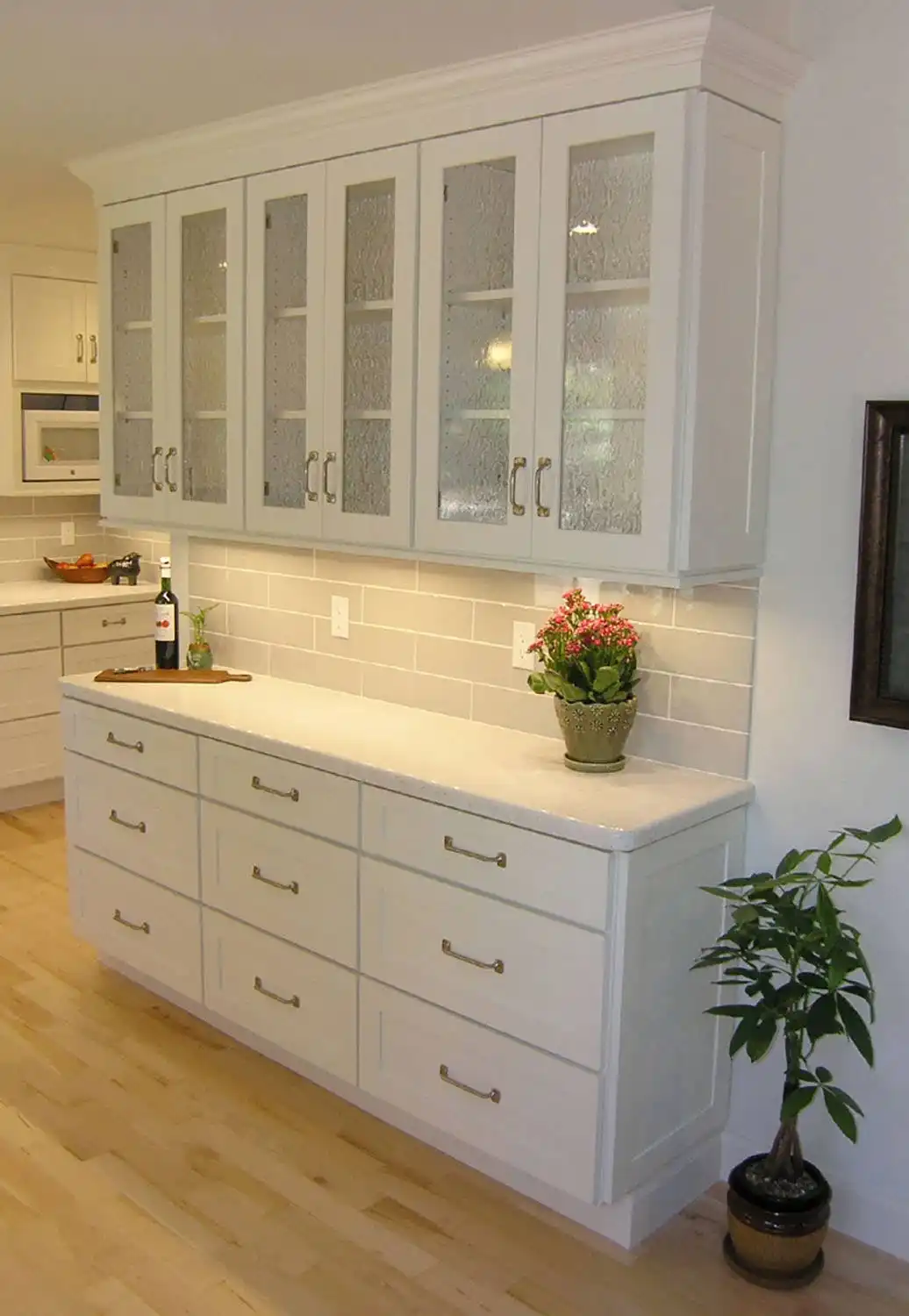
Shallow base cabinets are a practical kitchen storage solution for homeowners who want useful cabinet space without using the full depth of standard base cabinetry. They are especially valuable in small kitchens, narrow rooms, kitchen islands, utility areas, dining spaces, and layouts where maintaining comfortable walking space is important.
Unlike deeper base cabinets, shallow cabinets extend less from the wall or surrounding structure. This creates a more compact footprint while still providing storage and countertop space. Some modular kitchen systems specifically offer base cabinets around 15 inches deep, including configurations with doors, drawers, and combinations of both.
Choosing the right shallow base cabinets requires more than simply selecting the smallest cabinet available. You need to consider depth, width, countertop dimensions, storage requirements, appliances, plumbing, cabinet construction, drawer clearance, and how people move through the kitchen.
Contents Overview
- What Are Shallow Base Cabinets?
- How Deep Are Shallow Base Cabinets?
- Standard Base Cabinets vs Shallow Base Cabinets
- Why Choose Shallow Base Cabinets?
- Best Places to Use Shallow Base Cabinets
- Shallow Base Cabinets for Small Kitchens
- Shallow Cabinets for Kitchen Islands
- Shallow Cabinets for Narrow Kitchens
- Shallow Base Cabinets With Drawers
- Shallow Cabinets With Doors
- Best Items to Store in Shallow Cabinets
- Shallow Cabinet Materials
- Choosing the Right Cabinet Width
- Countertops for Shallow Base Cabinets
- Shallow Base Cabinets and Kitchen Appliances
- Shallow Cabinets for Utility and Laundry Rooms
- Advantages and Disadvantages
- Shallow Base Cabinet Design Ideas
- How to Plan a Shallow Cabinet Layout
- Common Mistakes to Avoid
- Frequently Asked Questions
- Conclusion
What Are Shallow Base Cabinets?
Shallow base cabinets are lower cabinets designed with less depth than conventional kitchen base cabinets. They are installed at floor level and can support a countertop or another work surface.
The exact dimensions vary between manufacturers and cabinet systems. For example, IKEA’s METOD system offers base cabinet frames with a 37 cm system depth, approximately 15 inches, alongside deeper 60 cm options.
In the U.S. IKEA SEKTION system, the manufacturer also lists specific base shallow cabinets with a 15-inch depth. These are available in multiple configurations, including one-door cabinets, drawer cabinets, and combinations of doors and drawers.
This makes shallow base cabinets different from simply cutting down a standard cabinet. They can be designed as a dedicated cabinet solution with dimensions and components intended for reduced-depth applications.
How Deep Are Shallow Base Cabinets?
There is no single universal depth for shallow base cabinets.
A cabinet may be considered shallow when its depth is substantially less than a conventional kitchen base cabinet. Some modular systems use approximately 15-inch-deep shallow base cabinets.
For example, IKEA lists METOD base cabinet options at 37 cm system depth, while its standard deeper option is 60 cm.
| Cabinet Type | Example Depth | Typical Use |
|---|---|---|
| Shallow base cabinet | Around 15 inches | Compact kitchens |
| Standard base cabinet | Around 24 inches | Main kitchen runs |
| Extra-deep cabinet | 24+ inches | Specialized storage |
| Custom shallow cabinet | Varies | Specific layouts |
Exact dimensions should always be checked with the manufacturer because cabinet depth can refer to the cabinet frame, total cabinet, or finished installation.
Standard Base Cabinets vs Shallow Base Cabinets
The biggest difference is the amount of space the cabinet occupies from front to back.
A standard base cabinet generally provides greater internal storage capacity but also takes up more floor space. A shallow cabinet sacrifices some storage depth in exchange for a smaller footprint.
| Feature | Shallow Base Cabinets | Standard Base Cabinets |
|---|---|---|
| Depth | Reduced | Deeper |
| Floor space | Uses less | Uses more |
| Storage capacity | Lower | Higher |
| Accessibility | Often easier | Can require deeper reaching |
| Small kitchens | Excellent | May feel bulky |
| Narrow rooms | Useful | Can restrict movement |
| Large cookware | Limited | Better |
| Counter space | Depends on design | More conventional |
Neither option is automatically better. The right choice depends on the room and what you need to store.
Why Choose Shallow Base Cabinets?
The main reason to choose shallow base cabinets is to make better use of limited space.
A deep cabinet can reduce the amount of open floor space available in a narrow kitchen. Reducing cabinet depth can create a more comfortable walkway and make the room feel less crowded.
Shallow cabinets can also improve access to smaller items because the contents are not pushed as far toward the back.
They are particularly useful when storage needs are moderate but floor space is limited.
Best Places to Use Shallow Base Cabinets
Shallow base cabinets can be used in many areas beyond a conventional kitchen.
Popular applications include:
- Small kitchens
- Apartment kitchens
- Narrow galley kitchens
- Kitchen islands
- Breakfast areas
- Home bars
- Utility rooms
- Laundry rooms
- Mudrooms
- Dining-room storage
- Pantry areas
- Secondary kitchen areas
The key is to use them where reduced-depth storage is more valuable than maximum cabinet capacity.
Shallow Base Cabinets for Small Kitchens
Small kitchens often benefit significantly from shallow cabinetry.
When every inch of floor space matters, reducing cabinet depth can make the room easier to navigate. It can also provide more visual breathing room between cabinets, appliances, doors, and walkways.
A shallow cabinet can hold frequently used items without dominating the room.
For example, a compact kitchen might use shallow cabinets for plates, cups, utensils, spices, food containers, and other relatively small items while reserving deeper cabinets for cookware.
Another advantage is that shallow cabinetry can make the kitchen appear less bulky.
Shallow Cabinets for Kitchen Islands
Shallow base cabinets can also be useful in kitchen islands.
An island does not always need deep storage on every side. A reduced-depth cabinet can provide storage while preserving more room around the island.
This can be particularly helpful in kitchens where the island sits close to another counter or wall.
Before choosing an island cabinet, measure the complete island footprint, including the countertop overhang and clearance around the island.
Shallow Cabinets for Narrow Kitchens
Narrow kitchens can be challenging because standard-depth cabinets may leave limited walking space.
Shallow base cabinets can help create a more comfortable layout by reducing the amount of cabinet projection into the room.
However, the cabinet should not be made shallow simply for the sake of saving space. You need enough depth for the countertop, doors, drawers, plumbing, and items you plan to store.
For particularly narrow kitchens, professional planning can help determine whether reduced-depth cabinetry is appropriate.
Shallow Base Cabinets With Drawers
Drawers can make shallow base cabinets even more useful.
Because shallow drawers have less depth, items can be easier to see and organize. You can use them for cutlery, utensils, kitchen tools, spices, towels, containers, and other relatively small items.
Some manufacturers offer shallow base cabinets with multiple drawers. IKEA’s SEKTION documentation, for example, includes 15-inch-deep base shallow cabinets with two, three, four, and six-drawer configurations.
A shallow cabinet with drawers can therefore provide excellent everyday storage without requiring a full-depth cabinet.
Shallow Cabinets With Doors
Door-style shallow cabinets are useful when you need enclosed storage.
They can hold plates, bowls, small appliances, cleaning supplies, pantry items, or other objects that do not need to be accessed constantly.
Adjustable shelves can make the interior more flexible.
IKEA’s METOD 30 × 37 × 80 cm base cabinet, for example, uses adjustable shelving and a reduced-depth frame.
Best Items to Store in Shallow Cabinets
The best items for shallow cabinets are generally those that do not require significant front-to-back storage space.
Good choices include:
| Item | Suitability |
|---|---|
| Cutlery | Excellent |
| Kitchen utensils | Excellent |
| Plates | Good |
| Small bowls | Good |
| Food containers | Good |
| Spices | Excellent |
| Cleaning products | Good |
| Towels | Excellent |
| Small appliances | Depends on dimensions |
| Large stock pots | May be limited |
| Large cookware | Better in deep cabinets |
Think about the dimensions of the actual items before selecting a cabinet.
Shallow Cabinet Materials
Shallow base cabinets are available in many materials and finishes.
Particleboard and engineered wood are common in modular systems, while plywood and solid wood are popular in custom cabinetry.
For example, IKEA’s METOD cabinet frames use particleboard with melamine foil and plastic edging.
| Material | Benefits | Considerations |
|---|---|---|
| Particleboard | Affordable and widely available | Quality depends on construction |
| Plywood | Strong and durable | Often costs more |
| MDF | Smooth finish | Moisture protection is important |
| Solid wood | Premium appearance | More expensive |
| Metal | Durable and modern | Less common for traditional kitchens |
Moisture resistance is particularly important around sinks and other wet areas.
Choosing the Right Cabinet Width
Depth is only one part of cabinet selection.
You also need to choose the correct width for the available wall or island space.
Shallow cabinet systems can be combined in different widths to create a customized layout. IKEA’s shallow cabinet documentation includes multiple width options, depending on the configuration.
Before ordering, create a complete cabinet plan showing:
- Wall length
- Cabinet widths
- Cabinet depth
- Door and drawer clearance
- Appliance openings
- Plumbing
- Electrical points
- Countertop dimensions
- Walkway space
This reduces the risk of ordering cabinets that cannot fit together correctly.
Countertops for Shallow Base Cabinets
A shallow base cabinet needs a countertop that works with the cabinet depth and intended use.
You should not assume that a standard countertop will automatically be appropriate for a reduced-depth cabinet.
Countertop material can include:
- Quartz
- Granite
- Solid surface
- Laminate
- Wood
- Porcelain
- Natural stone
The countertop should provide enough usable work surface while maintaining appropriate support and overhang.
If the shallow cabinet is being used for food preparation, consider how much front-to-back workspace you actually need.
Shallow Base Cabinets and Kitchen Appliances
Appliances require special attention.
Many major kitchen appliances are designed around standard cabinet dimensions. A shallow cabinet may therefore not be suitable for housing a standard-depth dishwasher, oven, refrigerator, or other appliance.
Always check the manufacturer’s installation dimensions before designing around an appliance.
For example, IKEA’s ENHET base cabinet for a built-in hob has a 62 cm overall depth, demonstrating that appliance-related cabinet dimensions can differ from reduced-depth storage cabinets.
Shallow cabinets are often best used beside appliances rather than assuming every appliance can fit inside them.
Shallow Cabinets for Utility and Laundry Rooms
Shallow base cabinets are not limited to kitchens.
They can be useful in laundry rooms where full-depth cabinetry would interfere with appliances or walking space.
They can also work in utility rooms for storing:
- Cleaning supplies
- Towels
- Laundry products
- Household tools
- Small storage containers
- Pet supplies
A shallow cabinet can provide useful storage without making a compact utility room feel crowded.
Advantages and Disadvantages
Like any cabinet style, shallow base cabinets have both benefits and limitations.
Advantages
- Save floor space
- Useful in narrow rooms
- Can improve accessibility
- Work well for small kitchens
- Suitable for islands
- Can provide drawer storage
- Create a lighter visual appearance
- Useful for small household items
Disadvantages
- Less storage depth
- Not ideal for oversized cookware
- Some appliances will not fit
- Countertop planning requires attention
- May require specialized cabinet components
- Reduced depth can limit storage flexibility
The goal is to use shallow cabinets strategically rather than replacing every standard cabinet with a shallow version.
Shallow Base Cabinet Design Ideas
There are several ways to make shallow cabinetry look attractive as well as functional.
Minimalist White Cabinets
White shallow cabinets can make a small kitchen feel brighter and more open.
Pair them with a light countertop and simple hardware for a clean appearance.
Wood-Look Shallow Cabinets
Wood finishes can introduce warmth into a compact kitchen.
Light oak, natural wood, and medium brown finishes work well with neutral countertops.
Handleless Shallow Cabinets
Handleless drawer and door fronts can create a streamlined appearance.
This can be particularly effective in small kitchens because the design reduces visual clutter.
Open and Closed Storage
Combine shallow base cabinets with open shelving or wall cabinets to create a mixture of display and concealed storage.
This gives you flexibility while keeping the lower part of the kitchen organized.
Shallow Island Storage
A shallow island can provide useful storage without creating an oversized obstruction in the center of the room.
This approach is particularly useful when there is limited space between the island and surrounding cabinets.
How to Plan a Shallow Cabinet Layout
Start by measuring the room carefully.
Record the exact wall lengths, ceiling height, door openings, windows, plumbing points, electrical outlets, and appliance locations.
Next, identify which items need storage.
If you mainly need space for utensils, plates, containers, and small kitchen tools, shallow cabinets may be highly practical.
If you need to store large pots, pans, countertop appliances, or bulky food supplies, combine shallow cabinets with deeper storage.
Finally, consider how the cabinet doors and drawers open. A cabinet may technically fit in a room but still create a problem if its door or drawer conflicts with an appliance, doorway, or another cabinet.
Common Mistakes to Avoid
One common mistake is assuming that every shallow cabinet has the same dimensions. Cabinet systems vary considerably, so always check the manufacturer’s specifications.
Another mistake is using shallow cabinets for items that need substantial storage depth.
It is also important to account for the finished countertop depth rather than looking only at the cabinet frame.
Do not forget about drawer and door clearance. A shallow cabinet can still create a circulation problem if it is installed too close to another fixture.
Finally, avoid choosing cabinets based entirely on appearance. Storage capacity, construction quality, hardware, and compatibility with appliances are equally important.
Frequently Asked Questions
What are shallow base cabinets?
Shallow base cabinets are lower cabinets designed with less depth than conventional kitchen base cabinets. They are useful when you want storage and countertop space while reducing the cabinet’s footprint.
How deep are shallow base cabinets?
There is no single universal depth, but some modular systems offer shallow base cabinets around 15 inches deep. IKEA, for example, lists 15-inch-deep shallow base cabinets in its SEKTION system and 37 cm-deep options in its METOD system.
Are shallow base cabinets good for small kitchens?
Yes. They can be especially useful in small or narrow kitchens because they take up less front-to-back floor space and can make movement easier.
What can I store in shallow base cabinets?
Shallow cabinets are well suited to cutlery, utensils, plates, containers, spices, towels, cleaning products, and other items that do not require significant depth. Large pots and bulky appliances may require deeper storage.
Can shallow base cabinets have drawers?
Yes. Shallow base cabinets can be designed with drawers, and some modular cabinet systems offer multiple drawer configurations. These can be particularly useful for organizing smaller kitchen items.
Conclusion
Shallow base cabinets are a smart option when kitchen storage needs to fit within a limited footprint. By reducing cabinet depth, they can help preserve walking space, improve accessibility, and create a less crowded appearance.
They are particularly useful in small kitchens, narrow layouts, islands, utility rooms, and other areas where standard-depth cabinetry may take up too much space.
When choosing shallow base cabinets, pay attention to exact dimensions, cabinet width, countertop depth, drawer and door clearance, materials, storage requirements, and appliance compatibility. A combination of shallow and standard-depth cabinets can often provide the best balance between accessibility and storage capacity.
With careful planning, shallow cabinetry can deliver a practical kitchen layout without sacrificing style or everyday functionality.


One thought on “Shallow Base Cabinets: Complete Guide to Sizes, Uses, Benefits and Kitchen Ideas”